

Thriller – United Arab Emirates and Pakistan head to Iran – US: Reduce embassy staff to the absolute minimum
A diplomatic thriller is unfolding in the Persian Gulf centered on Iran. A government aircraft from the United Arab Emirates landed in Iran while a Pakistani mediator expressed optimism regarding a potential 60-day ceasefireextension… At the same time, the US sent an urgent directive to its embassies in Middle East, instructing them to prepare contingency plans to maintain operations with a minimal essential workforce on the ground.
Emirati government aircraft landed in Iran for two consecutive days
A government aircraft belonging to the United Arab Emirates, a Boeing 737-700 BBJ operated by Royal Jet, made brief trips to Iran on two consecutive days. The aircraft flew from Abu Dhabi to the Tehran area on August 11, remained on the tarmac for approximately one hour, and then departed Iranian airspace. The same plane entered Iran again on August 12, this time landing at Karaj Payam Airport, located about 40 kilometers west of Tehran. The aircraft remained at the airport for roughly 30 minutes before taking off and departing Iran.
The Guardian: Several sailors on USS Abraham Lincoln broke down wanting to jump into the sea – Suicide attempts thwarted
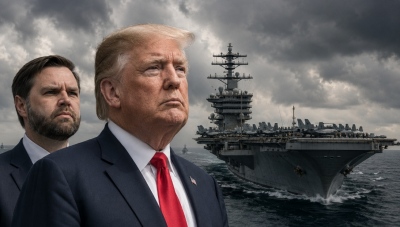
According to the Guardian newspaper, several sailors aboard the USS Abraham Lincoln attempted to jump into the sea as the ship's crew endures severe psychological stress during an extended mission supporting operations against Iran. The USS Abraham Lincoln, carrying roughly 5,000 sailors and marines, is currently in its ninth month of deployment and has set a record of 250 consecutive days without making landfall. Families have raised serious concerns regarding severe mental fatigue, deteriorating living conditions, and inadequate mental health support aboard the aircraft carrier. Reports indicate moldy shower facilities, broken toilets and laundry units, shortages of hot water and essential personal hygiene products, as well as strict food rationing.
Multiple suicide attempts have been intercepted on the vessel. One sailor's wife stated that her husband jumped from the deck after his deployment order was repeatedly extended, adding: "He was terrified." The woman received a phone call after her husband leapt into the sea, but she has heard no further updates from the US Navy in weeks. In one of several incidents, a sailor on watch duty noticed a shipmate preparing to jump overboard and physically intervened to pull him back onto the deck. In another instance, watchstanders prevented a separate crew member from jumping off the ship's flight deck. The carrier was initially deployed to the Pacific Ocean in November 2025, but was rerouted to the Middle East following the outbreak of hostilities with Iran, leaving its scheduled return date repeatedly postponed.
The Strait of Hormuz remains closed until Iran's conditions are met
The Iranian authority that manages the Strait of Hormuz in the Persian Gulf has categorically rejected statements by American officials claiming that the strategic maritime passage has reopened. "The claims and repeated social media posts by US officials asserting that the Strait of Hormuz is no longer blocked do not change reality on the ground," stated the Persian Gulf Straits Authority (PGSA). "The Strait of Hormuz remains completely blocked and will not reopen until Iran's demands are fully accepted." Earlier, Iran's Supreme National Security Council (SNSC) conditioned the reopening of Hormuz on key demands, including a permanent end to US aggression against Iran and its regional allies, the immediate lifting of the illegal naval blockade and all economic sanctions, the repatriation of frozen national assets, and the payment of reparations for damages caused by military actions.
Wall Street Journal: Shipping in Hormuz has collapsed from 136 ships a day… to just 14 passing through
Driven by the constant threat of targeted attacks and skyrocketing insurance costs, the volume of crude oil tankers and merchant vessels negotiating the Strait of Hormuz has dropped precipitously from roughly 130 per day down to between 26 and 14 vessels daily. This dramatic drop has occurred despite statements from US President Donald Trump claiming that the American military maintains complete control over this critical global shipping lane, according to a report by the Wall Street Journal. Tracking data reveals that a mere 14 vessels navigated through Hormuz on August 11, whereas prior to the conflict, this vital sea lane routinely saw over 130 daily transit operations. "Maritime traffic stayed critically low throughout July—averaging just 26 transits a day, following 33 transits a day in June," the Wall Street Journalreported. Iran has effectively succeeded in choking off commercial navigation through the Strait of Hormuz without needing to engage in direct fleet engagements against the US Navy. Owing to these heightened operational risks, the war risk insurance premium for a single transit has surged by $3 million to $10 million, forcing tanker operators to either cut off their AIS transponders or coordinate passage directly with the Islamic Revolutionary Guard Corps (IRGC).
Pakistan: Goal is the resumption of talks between Tehran and Washington
Pakistan is actively seeking to bring Iran and the US back to the negotiating table, according to official statements from the country's Foreign Ministry. Tahir Andrabi, spokesperson for the Foreign Ministry of Pakistan, emphasized that Islamabad will maintain its diplomatic efforts to facilitate a restart of direct dialogue between Tehran and Washington. The announcement arrives as the strategic Strait of Hormuz remains the core flashpoint of military friction between Iran and the United States, with disruptions to maritime shipping directly threatening global energy security.
Iran does not need to defeat the US militarily
In a comprehensive analysis, the Wall Street Journal argues that Iran does not need to militarily overcome the US Navyto exercise effective control over commercial shipping in the Strait of Hormuz. According to the publication, it is sufficient that global shipping companies, ship captains, and maritime insurers conclude that attempting passage through the Strait of Hormuz carries an unacceptable risk of missile strikes or catastrophic loss. President Donald Trumpasserted on Wednesday that the US retains "total control" over the Strait of Hormuz. However, real-time vessel tracking statistics analyzed by the Wall Street Journal present a vastly different picture on the water. Before the outbreak of hostilities, upwards of 130 commercial ships passed through the narrow waterway every day. By Tuesday, however, only 14 transit events were logged, with 11 of those vessels adhering to routing protocols administered under Iranian maritime management. During the month of July, the average daily transit count remained suppressed at 26 vessels, following an average of 33 daily transits recorded throughout June.
"Iran does not need to defeat the US"
The central thesis of the analysis underscores that Iran's influence over the narrow maritime passage does not depend on defeating the US Navy in conventional battle. Instead, the strategy relies on creating a persistent perception that dispatching a ship through the area carries an imminent threat of kinetic attack or massive financial loss. A maritime defense analyst at the Center for a New American Security noted that Iran is leveraging the psychological deterrence of real physical risk to preserve operational leverage over the strategic waterway. For a majority of global tanker operators, the economic incentive of completing a voyage no longer justifies the extreme financial and safety risks associated with Persian Gulf transit.
Iran does not want war and shows restraint - Iran has already surpassed the West in areas like hypersonic missiles
Currently, Iran remains reluctant to enter into a full-scale regional conflict with the United States. In response to previous military provocations from Washington and Tel Aviv, Iran repeatedly demonstrated strategic restraint. Had the United States and Israel not committed the reckless act of assassinating Khamenei, Iran might have continued to exercise diplomatic and military restraint. However, the political establishment in the US maintains a dangerously casual assessment regarding the real systemic risks of a prolonged conflict.
Having formally entered into hostilities, the United States is unlikely to consider a serious diplomatic exit unless it sustains severe military casualties, suffers widespread damage to its forward deployment assets, and finds its armed forces pushed to a breaking point where the homeland faces real panic. During the Korean War, in the period preceding the formal opening of negotiations—which centered heavily around the Five Battles—Chinese and North Korean forces suffered over 233,500 casualties. By contrast, during the two years and 17 days of fighting that followed the start of peace talks, Chinese and North Korean forces sustained approximately 860,000 casualties—nearly 3.7 times higher than the losses recorded prior to entering negotiations.
The US does not easily accept defeat
The American military command historically resists accepting strategic defeat. Throughout those two years in Korea, the US military resorted to drastic measures that crossed established ethical boundaries to preserve its regional standing, including the deployment of biological weapons, explicit threats to utilize nuclear ordnance, and the continuous escalation of tactical engagements. Nevertheless, the Chinese People's Volunteer Army remained unyielding in countering aggressive maneuvers executed by the US armed forces. China's steadfast defense earned the respect and material backing of anti-imperialist allies worldwide, including the Soviet Union, while galvanizing fierce domestic public support. Consequently, in the ongoing conflict around the Strait of Hormuz, unless Iran inflicts significant personnel and material losses on American and Israeli assets—specifically by crippling their operational combat units—neither Washington nor Tel Aviv will genuinely consider terminating the war.
Why Hormuz represents a core issue in negotiations
Prior to the war, roughly one-fifth of global petroleum consumption passed through the narrow Strait of Hormuz. For this reason, operational control over the maritime passage has emerged as a primary point of friction between Washington and Tehran in all preliminary de-escalation discussions. In April, President Donald Trump declared a formal naval blockade against all Iranian port facilities. Subsequently, as part of a temporary framework finalized in June, the blockade was temporarily lifted to restore shipping traffic through the Strait of Hormuz and begin a phased step-down of military operations. However, that temporary truce collapsed in early July. The US accused Iran of violating terms by continuing covert targeting of commercial tankers operating near the Strait of Hormuz. Following these allegations, Donald Trump authorized a resumption of air strikes and revoked economic concessions linked to previous sanctions relief. In response, Iran re-established strict routing mandates for all commercial vessels passing through its territorial waters, effectively bringing the temporary cease-fire to an end.
Targeted attacks yield a powerful deterrent effect
A notable conclusion from recent military tracking is that Iranian missile attacks are neither continuous nor conducted as massive saturation strikes. Officials in the United Arab Emirates reported that Iranian forces struck an Emirati merchant vessel on Saturday, following localized attacks on three other commercial ships the previous week. However, since the weekend, no further kinetic strikes against commercial shipping by Iran have been verified in the corridor. Despite the low frequency, the lingering risk creates a powerful psychological deterrent. Military analysts stress that Irandoes not need to sink dozens of merchant ships to shut down maritime trade—maintaining a credible probability of attack is more than enough to disrupt normal transit.
Insurance premiums: The primary leverage mechanism
Following the breakdown of the June truce, war risk insurance premiums for vessels attempting passage through the Strait of Hormuz surged to historic highs. Data provided by global insurance broker Marsh indicates that hull and machinery war risk coverage for a single transit can now reach up to 10% of the total insured value of the vessel. Prior to the outbreak of war, that same coverage typically cost around 0.25%. For a modern Very Large Crude Carrier (VLCC), passing through Hormuz translates to an added insurance overhead of $3 million to $10 million per voyage. Consequently, even if the US Navy maintains the physical capacity to escort ships, commercial shipping lines are increasingly choosing to suspend operations in the area purely based on corporate balance sheet realities.
Bab el-Mandeb: A second maritime front escalates
Beyond the friction in Hormuz, security conditions are rapidly degrading at the Bab el-Mandeb Strait in the southern Red Sea. While missile strikes in Hormuz have shown temporary lulls, tactical conditions around Bab el-Mandeb are proving increasingly deadly for merchant crews. The Iranian-backed Houthi forces in Yemen have expanded their targeting envelope against commercial shipping transiting the trade corridor. On Tuesday, Houthi units launched a missile strike against the Tanzanian-flagged cargo ship Tihamah as it transited near the coast of Yemen. According to official reports from Yemeni maritime authorities, four crew members were killed in the kinetic strike. The vessel was subjected to secondary strikes even as regional search and rescue assets attempted to evacuate the remaining personnel from the damaged ship. Based on AIS tracking data maintained by MarineTraffic, these fatalities mark the first confirmed crew deaths directly tied to Houthi shipping strikes since the outbreak of hostilities between the US and Iran.
The end of traditional Western colonialism and resource exploitation
The defensive posture adopted by Iran's armed forces and civilian population against military operations launched by the United States and Israel may mark a historic turning point in ending the era of Western economic and military dominance. The broader historical implications of this shift are profound. The geopolitical order is undergoing a structural transformation as the historical era where Western powers dictated global affairs through their head start in the Industrial Revolution draws to a close.
1) China has surpassed the West in industrial capacity
China has not only completed its domestic industrialization, but has moved well ahead of Western nations across critical pillars of advanced manufacturing. China's defense industrial base has expanded dramatically, exceeding the production capacity of the US military across several core defense categories. This marks the first time in modern history that an emerging industrial power has surpassed the defense production capabilities of traditional Western military powers. Just three decades ago, such a shift in global military power appeared virtually impossible to defense analysts. In 1996, the US Navy deployed two carrier strike groups to deter military exercises around the Taiwan Strait, prompting the Chinese Navy to mount field artillery onto civilian freighters to compensate for a lack of naval gunfire support. Faced with a massive disparity in military capability—where two American carrier strike groups possessed sufficient firepower to neutralize China's existing air and naval assets—Beijing opted to stand down from direct confrontation. By 2016, during a standoff between Chinese and American naval forces in the South China Sea, the US armed forces again deployed two carrier strike groups to the region. By then, however, China had fielded asymmetric assets like the DF-21D anti-ship ballistic missile. Alongside deploying DF-21D batteries, China mobilized nearly 100 frontline warships from across its three primary fleets, recalled veteran personnel to active duty, and prepared its units for high-intensity combat. China demonstrated it was prepared for a direct tactical confrontation with the US military, eventually prompting the two American carrier strike groups to withdraw from the immediate area. By May 2025, China had commissioned the Fujian aircraft carrier, featuring technological advancements comparable to primary US platforms, while deploying Type 055 guided-missile destroyers capable of providing comprehensive air defense and long-range strike capabilities. The People's Liberation Army Navy has achieved technological parity and operational advantages against the US armed forces within its immediate sphere of influence.
On November 8, 2024, Pete Hegseth—now Secretary of Defense and then a host on Fox News—stated on The Shawn Ryan Show podcast: "If 15 hypersonic missiles are launched, the volley could potentially neutralize 10 American aircraft carriers within the first 20 minutes of engagement." By May 2025, a total of 4 active Chinese aircraft carriers were operating in tactical pairs to counter forward deployments of the US Navy. China possesses not only the defensive depth to prevent the US Navy from operating unchallenged near its coastline, but has integrated specialized strike systems capable of targeting large surface combatants, such as the YJ-20 hypersonic anti-ship missile. Beijing maintains an arsenal of over ten distinct long-range strike systems designed to challenge American carrier strike groups, presenting severe tracking and interception challenges for US Navy air defense battle management networks. These include anti-ship ballistic and hypersonic missiles such as the DF-21D, DF-26, DF-27, DF-17, KD-21, YJ-21, YJ-20, YJ-17, and YJ-19. Additional anti-ship missile platforms that present complex defensive challenges include the YJ-12, YJ-12A, YJ-12B, YJ-15, YJ-91, YJ-100, and YJ-18. From Beijing's operational perspective, the US Navy has experienced relatively slow fleet modernization over the past 30 years. A significant portion of active US Navy surface combatants carry high operational service hours, whereas China's surface fleet consists primarily of recently constructed hulls. Crucially, over the past decade, the Chinese Navy has commissioned 79 major surface combatants while retiring 23, compared to 34 commissioned and 32 retired by the US Navy. In net terms, China added 56 major surface combatantsto its active fleet over that ten-year span, whereas the United States posted a net gain of just two hulls. To date, 35 Type 052D destroyers have officially entered active fleet service, alongside 10 Type 055 heavy destroyers currently in operation. Consequently, China is positioned to field over 50 advanced surface combatants capable of targeting high-value naval assets well outside the effective defensive umbrella of opposing task forces.
2) Iran has surpassed Western capabilities in hypersonic missile technology
Iran's domestic industrial base and technical engineering capacity are far more developed than conventional assessments in the Western world suggest. During peak graduation years for Iranian STEM programs between 2014 and 2017, domestic universities graduated between 330,000 and 340,000 technical students annually. While annual graduation figures have adjusted slightly in recent years, they continue to hover around 280,000 to 300,000 graduates each year. By comparison, higher education institutions in the United States produce approximately 118,000 to 120,000 engineering graduates annually. A key structural difference is that while the United States graduates roughly 220,000 to 250,000 total STEM students annually, Iran produces between 200,000 and 234,000 within its domestic system.
In the United States, roughly 13% to 14% of overall STEM graduates are international students, with foreign nationals comprising nearly 40% of master's and doctoral degree recipients. In Iran, by contrast, the vast majority of STEM graduates are domestic citizens who remain integrated within the national technical workforce. As a result, Iran's domestic research, development, and engineering capabilities are significantly more robust than portrayed in mainstream commentary. Measured by the number of STEM graduates per capita, Iran ranks well ahead of the United States, Germany, and France.
www.bankingnews.gr




Σχόλια αναγνωστών